Concrete Expansion Joints in Greensboro, NC: Expert Strategies to Prevent Cracking and Ensure Durability
Concrete expansion joints are planned gaps or flexible interfaces in slabs that absorb movement and relieve stress, preventing random cracking and extending service life. In Greensboro’s mixed-humid climate, thermal expansion, seasonal shrinkage, freeze-thaw events, and soil movement combine to produce tensile forces in concrete; expansion joints channel those forces into controlled openings so slabs remain intact. This guide explains causes of cracking, the specific roles of expansion, control, and isolation joints, and how correct material selection and placement reduce maintenance costs and safety risks. You will learn which joint types suit residential driveways, sidewalks, and commercial slabs, how polyurethane and polyurea compare to rubber and foam, and what professional repair and routine maintenance should include. The article maps to practical inspection schedules, cost-influencing factors, and preventative best practices so property owners and facility managers in Greensboro can choose durable, weather-resistant solutions. Read on for clear recommendations, side-by-side material comparisons, and actionable steps to prevent concrete damage and extend slab life.
Concrete Expansion Joints in Greensboro: Crack Prevention Strategies
Concrete cracking in Greensboro results from several interacting mechanisms—thermal movement, plastic and drying shrinkage, freeze-thaw cycles, subgrade settlement, and imposed loads—that induce tensile stress exceeding concrete’s low tensile strength. Expansion joints function by providing a planned weak point or flexible interface that isolates movement, allowing slabs to expand and contract without transferring destructive forces to the surrounding concrete. Proper joint spacing and installation turn unpredictable stresses into predictable gaps, which reduces random cracking and concentrates repairable wear at the joint line rather than across the slab. Understanding these mechanisms is essential before selecting joint types, as the next section will examine thermal effects in detail and show how spacing relates to movement accommodation.
Concrete damage in Greensboro often starts with microcracking from repeated cycles, which then propagate into visible faults when not controlled. Expansion joints arrest that progression by decoupling slab sections and by allowing sealant systems to accommodate movement, which preserves surface finishes and load-bearing capacity. The practical recommendation is to design joints during initial construction or retrofit them in repair work, since retrofitted joints and proper sealing both reduce water intrusion and freeze-thaw damage that accelerate deterioration.
The following list summarizes the primary local causes and links each to how expansion joints mitigate the effect.
- Thermal expansion and contraction create lateral and longitudinal stresses; joints provide free edges to relieve those stresses.
- Drying and plastic shrinkage pull the slab inward as moisture leaves; control joints create intentional crack locations to prevent random cracking.
- Freeze-thaw and water intrusion expand and displace paste and aggregates; sealed joints block moisture pathways and reduce spalling.
These causes and mitigations clarify why targeted joint design is a cost-effective preventative strategy that reduces the need for later patching and replacement, which the next subsection details through thermal coefficients and numeric examples.
How Does Thermal Expansion and Contraction Affect Concrete Integrity?
Thermal expansion and contraction occur because concrete changes length with temperature; even a small coefficient of thermal expansion multiplied by large slab dimensions produces millimeters of movement that accumulate stress. Concrete’s thermal coefficient (on the order of 6–12 × 10 /°F) means a 40-foot slab can shift up to about 0.3 inches across seasonal cycles, and repeated daily fluctuations create fatigue that drives microcrack growth. Expansion joints accommodate that movement by providing compressible filler and flexible sealant so expansion does not force one slab against another or against fixed elements. For practical design, joint spacing is determined by slab length, expected temperature range, and reinforcement—shorter spacing reduces stress concentration and helps prevent random cracking in high-variation environments like Greensboro.
A simple example helps illustrate the concept: a 20-meter (≈66 ft) unjointed slab that expands by only a few millimeters per 10°F change can build large restraining forces if held fixed, leading to tensile failure at weak points. By using joints at prescribed intervals and specifying appropriate movement-capable sealants, engineers turn distributed stress into localized, manageable movement. This mechanical view leads directly into why expansion joints are essential given Greensboro’s seasonal swings, which the next subsection connects to local climate patterns and inspection timing.
Why Are Expansion Joints Essential for Preventing Concrete Cracks in Local Climate?
Greensboro’s climate combines hot summers, cooler winters, periodic freeze events, and humid conditions that increase moisture-driven shrinkage and freeze-thaw damage; these seasonal patterns raise the probability of thermal and moisture-induced cracking. Expansion joints are essential because they allow the slab system to respond predictably to these local stressors rather than forming unpredictable cracks that compromise appearance and structural performance. Strategically placed joints, filled with weather-resistant sealants and paired with proper drainage, reduce water ingress and freeze-thaw spalling, which in turn limits long-term maintenance requirements. Inspecting joints seasonally—late winter after freeze cycles and early summer after thermal expansion—lets owners address sealant loss, debris accumulation, or filler degradation before cracks propagate.
Pay attention to joint spacing and material selection based on exposure: exterior driveways and sidewalks need durable UV- and water-resistant sealants, while interior or covered slabs may use different fillers. A focused inspection and reseal schedule tied to local weather patterns prevents small issues from growing into slab replacements, which naturally leads into the next major area: selecting joint types suited for specific Greensboro applications.
Which Types of Concrete Expansion Joints Are Best Suited for Greensboro Applications?
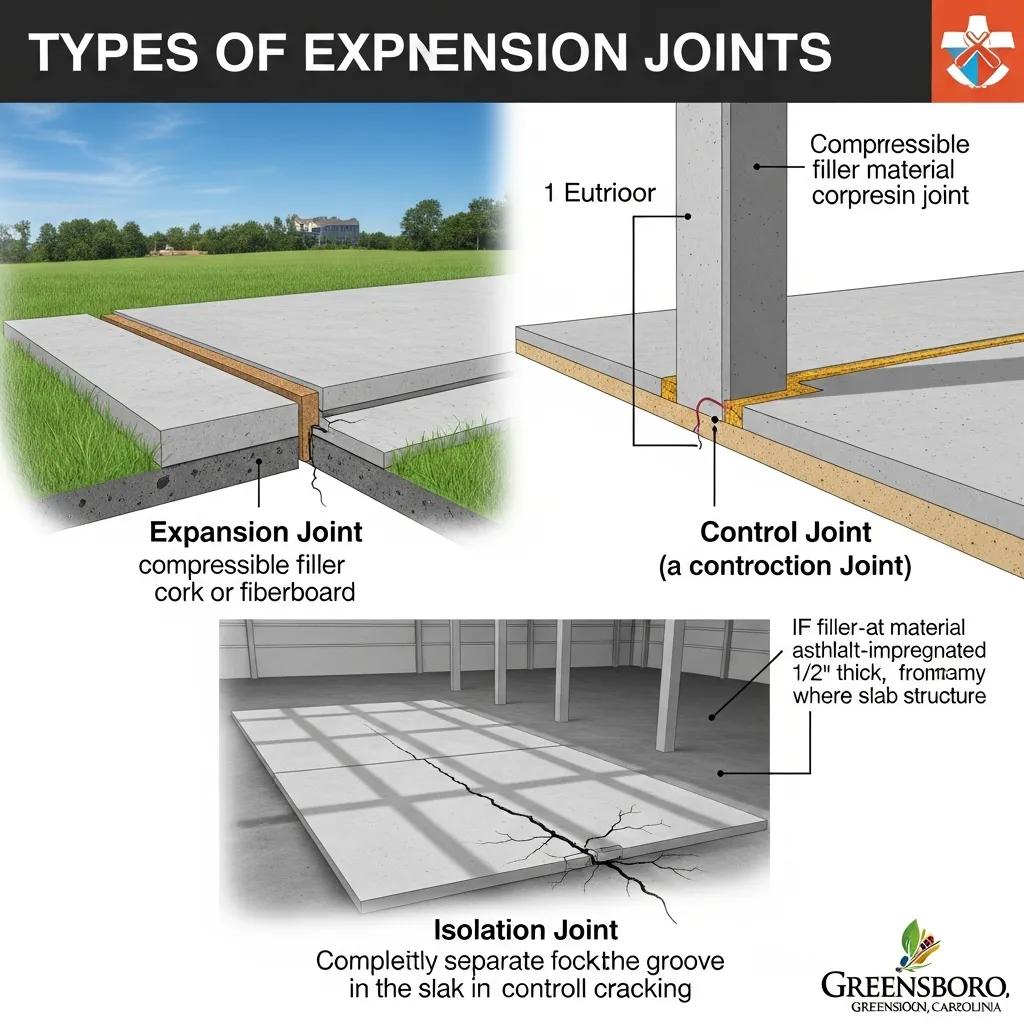
Choosing the right joint type begins with understanding the function: expansion joints accommodate dimensional change, control joints direct where shrinkage cracks form, and isolation joints separate slabs from fixed elements to prevent transfer of stress. Each joint type meets a different technical need—expansion joints use compressible fillers and sealants to absorb large movements, control joints are saw-cut or formed grooves that encourage cracking in predictable lines, and isolation joints isolate slabs from columns, walls, or curbs. Proper selection by application—driveway, sidewalk, parking deck, or slab on grade—reduces crack incidence and simplifies maintenance planning. The following comparative list clarifies the primary use-cases and helps property owners select the appropriate joint strategy.
Common joint types and their ideal applications include:
- Expansion Joints: Use where slabs meet fixed structures or where temperature-driven movement is large, such as against building foundations or long roadway sections.
- Control Joints: Use routinely in slabs on grade like residential driveways and patios to create predictable crack lines and improve aesthetics.
- Isolation Joints: Install around columns, equipment pads, or between different slab pours to prevent load transfer and differential movement.
Understanding these distinctions informs placement and spacing rules addressed in the next subsection, which gives prescriptive guidance for maximum crack prevention.
What Are the Differences Between Expansion, Control, and Isolation Joints?
Expansion joints are compressible interfaces intended to absorb large movement and are typically filled with backer rod and a flexible sealant; they prevent slabs from pressing against each other or fixed elements. Control joints are shallow saw cuts or formed grooves that create a plane of weakness and direct shrinkage cracking to a neat line; they do not typically include deep filler unless sealed. Isolation joints are full-depth separations that decouple the slab from adjacent structures or elements, preventing stresses from being transferred to the slab. Each uses different installation methods—saw-cutting for control joints, pre-formed strips or backer rod plus sealant for expansion joints, and full-depth separators or compressible wedges for isolation joints—and misapplication leads to failure modes such as spalling at sealed edges or jagged random cracks when spacing is wrong.
Comparing mechanisms highlights when each type protects the slab: expansion joints absorb bulk movement, control joints sacrifice a controlled line to protect the rest of the slab, and isolation joints prevent external constraints from distorting slab behavior. Recognizing these functions enables better design decisions and prepares owners for placement rules that follow in the next subsection.
Where Should Each Type of Joint Be Installed for Maximum Crack Prevention?
Placement depends on slab size, thickness, reinforcement, and fixed features; general rules of thumb apply for many Greensboro applications. For control joints in slabs on grade, spacing is commonly 24–36 times the slab thickness in inches (for example, 4-inch slab thickness → 8–12 feet spacing), while expansion joints belong where the slab meets fixed structures or at large slab breaks. Isolation joints should surround columns, curbs, and structural penetrations, creating a continuous compressible barrier to keep slab loads from transferring. For heavy-traffic commercial slabs and parking decks, closer spacing and more robust expansion systems—often using polyurethane or polyurea sealants—are recommended to handle load-induced movement and vehicular stresses.
Decisions also hinge on slab reinforcement and expected loads; slabs with continuous reinforcement may require different joint strategies than plain slabs. When in doubt, prioritize joints at predictable stress concentrators—changes in geometry, boundaries with different materials, or large uninterrupted slab areas—to minimize random cracking and simplify maintenance, which leads naturally into material selection considerations.
What Are the Best Expansion Joint Materials for Greensboro’s Climate and Concrete Surfaces?
Selecting joint materials requires balancing flexibility, UV resistance, water resistance, adhesion, and expected lifespan against exposure and traffic loads; common options include polyurethane, polyurea, rubber, closed-cell foam, asphalt, and fiber board. Polyurethane and polyurea sealants provide high elasticity and good adhesion for many exterior and heavy-traffic applications, making them suitable for Greensboro’s thermal cycles and occasional freeze events. Simpler fillers like closed-cell foam or asphalt offer economical gap-filling but often need more frequent replacement and may allow water infiltration if not sealed properly. The table below compares core attributes to guide material choice for specific surfaces and exposure conditions.
This materials comparison highlights performance and best-use scenarios for Greensboro installations:
How Do Polyurethane and Polyurea Sealants Compare for Durability and Flexibility?
Polyurethane sealants offer a balance of elasticity, good UV stability, and long-term movement accommodation, making them versatile for exterior concrete in mixed-humid climates. Polyurea cures faster and resists abrasion and chemicals more effectively, which suits heavy-traffic commercial floors and parking decks but may require specialized application equipment and surface preparation. Movement-range and recovery rates are comparable for many modern formulations; however, polyureas generally tolerate heavier mechanical wear while polyurethanes provide proven UV resilience for exposed sidewalks and driveways. Installation considerations include cure time—polyurea cures very quickly, which shortens downtime but demands rapid tooling—whereas polyurethane provides a longer working window for hand finishing and is more forgiving on variable surfaces.
Given these trade-offs, choose polyurea where rapid return-to-service and abrasion resistance are critical, and prefer polyurethane for exposed, UV-exposed exterior joints where long-term elasticity matters. Understanding these performance attributes points to appropriate filler pairings and backer rod choices, which the next subsection examines in the context of rubber, foam, asphalt, and fiber options.
What Are the Pros and Cons of Rubber, Foam, Asphalt, and Fiber Fillers?
Rubber fillers compress and recover well under repeated loading but can degrade under prolonged UV exposure unless protected with a UV-stable sealant; they are useful where compressive cycling is frequent. Closed-cell foam backer rods are inexpensive, prevent sealant three-sided adhesion, and maintain shape under modest movement, but they do not provide structural support and must be paired with a compatible sealant. Asphalt-based fillers can be economical and water-resistant initially but tend to oxidize and crack over time in high-UV conditions. Fiber board is rigid and inexpensive for forming isolation joints during construction but often requires a sealant overlay for long-term weather protection. Each filler’s failure modes—UV degradation, water absorption, extrusion, or loss of compression set—should guide selection based on exposure and maintenance willingness.
When lifespan and low maintenance are priorities, pairing a resilient backer (closed-cell foam) with a durable sealant (polyurethane or polyurea) typically provides the best balance of performance and cost-effectiveness in Greensboro installations.
How Can Professional Concrete Expansion Joint Repair and Sealing Services in Greensboro Prevent Cracking?
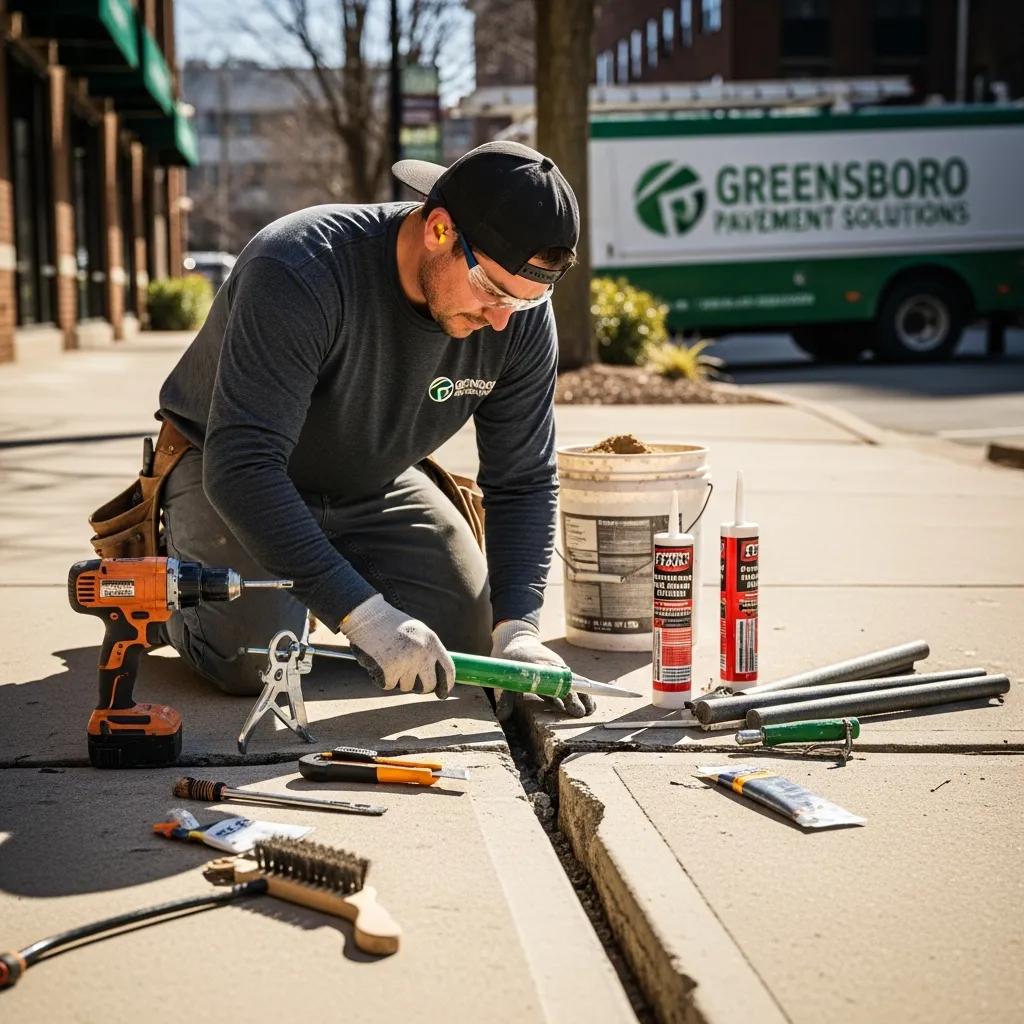
Professional repair and sealing services prevent cracking by diagnosing movement patterns, removing failed materials, and installing appropriately sized backer rods and modern sealants that match the site’s movement demands and exposure conditions. Local contractors and professional services bring specialized tools, experience with joint configuration and substrate preparation, and the ability to specify materials—such as polyurethane or polyurea—that meet both movement and weather-resistance requirements. These services often include warranty options and quality-control testing that reduce recurrent failures, and professionals can integrate drainage corrections or slab stabilization measures to address root causes rather than just treating visible symptoms. The next paragraph outlines a typical expert workflow so owners can compare DIY versus professional approaches.
Professional installations focus on long-term durability by combining correct diagnosis, materials, and execution; the result is reduced water intrusion, lower freeze-thaw damage, and fewer unsightly repairs over time. Below is a standard checklist of steps a professional crew will follow to ensure long-lasting joints and to minimize future cracking.
A professional repair and installation workflow typically includes:
- Inspection and diagnosis: Identify movement patterns, load influences, and subgrade issues.
- Removal of failed materials: Cut out old sealant and deteriorated filler to sound substrate.
- Surface preparation and cleaning: Remove debris, dry surfaces, and profile the joint for adhesion.
What Does Expert Installation and Repair Include for Long-Lasting Concrete?
Expert installation follows a repeatable sequence: inspect and document joint condition, remove old filler and sealant, clean and dry the joint cavity, install correct-size backer rod to set sealant depth, apply the specified sealant with proper tooling, and allow recommended cure time under controlled conditions. Quality-control checks include adhesion tests, movement simulation to confirm elasticity, and surface finishing to prevent ponding that could reduce sealant life. Professionals also select joint material combinations that match expected movement ranges—polyurea for heavy abrasion, polyurethane for exposed surfaces—and provide written maintenance recommendations to preserve the system. These steps reduce common failure modes such as three-sided adhesion, inadequate sealant depth, and premature UV degradation.
By ensuring the right depth-to-width ratio and using competent substrate preparation, professional repairs minimize recurring failures and prolong slab life, which is especially valuable for high-traffic or critical infrastructure; the next subsection explains when to choose a pro rather than attempt DIY remedies.
When Should You Choose Professional Services Over DIY Solutions?
Choose professional services when joints show structural movement, wide or recurrent cracks, evidence of subgrade settlement, or when working on high-traffic commercial slabs where failure has safety or liability implications. DIY sealing can be acceptable for shallow control joints or small aesthetic cracks when the owner uses compatible backer rod and sealant and follows manufacturer instructions, but owners should avoid DIY for joints adjacent to foundations, equipment pads, or where saw-cutting, deep removal, or slab stabilization is needed. Professionals mitigate risk through accurate diagnosis and by using industrial-grade sealants and surface preparation tools that are difficult for most homeowners to access. For many property owners, the reduced frequency of repairs and the improved durability of professional work offset higher upfront costs.
Recognizing when a job exceeds DIY scope helps preserve slab integrity and directs owners to seek professional inspection and repair options, which also informs budgeting and cost considerations covered next.
What Are the Costs and Benefits of Concrete Joint Repair and Maintenance in Greensboro?
Costs for joint repair and maintenance vary with material choice, joint length, required prep work, accessibility, and traffic control needs, while benefits include extended slab life, reduced water intrusion, improved safety, and lower long-term repair frequency. Investing in higher-performance sealants like polyurethane or polyurea often increases initial cost but reduces replacement frequency and lifecycle expense. Key cost-influencing factors include sealant unit price, labor intensity for removal and prep, and whether slab stabilization or drainage correction is required. The table below summarizes common cost factors, their impact, and tips to manage expense while maintaining performance.
Common cost drivers and practical tips are summarized here:
How Does Investing in Expansion Joint Repair Save Money Long-Term?
Investing in proper expansion joint repair reduces the likelihood of extensive slab replacement by preventing water intrusion, undermining of subbase materials, and progressive spalling that lead to costly structural repairs. A reliable seal and backer rod combination prevents moisture-driven damage that would otherwise expand freeze-thaw cycles and accelerate aggregate/paste deterioration, meaning fewer interventions over the slab’s life. By extending service life and limiting emergency patching, owners realize lower total cost of ownership and reduced liability from tripping hazards or surface failures. This preventive-nature narrative justifies the upfront expense of quality materials and professional installation as a cost-avoidance strategy.
Evaluating long-term maintenance budgets against the cost of partial or full slab replacement often shows that scheduled resealing and timely joint repair are economically superior; the next subsection lists local factors that influence actual price ranges in Greensboro.
What Factors Influence the Cost of Concrete Joint Services Locally?
Local factors include seasonal demand spikes, labor rates, local material availability, permit or inspection requirements for public works, and contractor lead times. Greensboro’s seasonal cycles may concentrate work in spring and fall, increasing short-term prices; off-season scheduling can sometimes reduce labor costs. Material selection—polyurea versus polyurethane or simpler fillers—directly affects unit costs and expected service intervals. Accessibility and traffic control needs, especially for commercial sites or busy sidewalks, increase labor and coordination time. To reduce cost, owners can consolidate nearby joint repairs, select durable materials appropriate to exposure, and schedule work during periods of lower contractor demand.
Knowing these local variables empowers owners to solicit multiple quotes, compare material-life trade-offs, and time projects to minimize cost while retaining performance, which feeds into practical maintenance scheduling discussed in the final H2.
What Are Effective Preventative Maintenance Strategies to Extend Concrete Life in Greensboro?
An effective maintenance strategy combines scheduled inspections, timely resealing, correct curing and drainage management, and prompt repairs of identified issues to extend concrete life and prevent cracking. Annual or biannual inspections—after winter and before summer—catch degraded sealant, filler extrusion, debris accumulation, and signs of subgrade movement; resealing intervals depend on material: polyurethane often requires reseal every 5–7 years while polyurea may last longer under heavy traffic. Proper curing for new pours, combined with slope and drainage corrections to keep water away from joints, reduces shrinkage and avoids undermining. The maintenance checklist below provides actionable items that owners can implement or ask local contractors to follow.
Preventative maintenance checklist for concrete joints:
- Inspect joints seasonally: Look for sealant failure, gaps wider than the design, or signs of water pooling.
- Reseal according to material schedule: Plan resealing on a 5–7 year cycle for polyurethane or per manufacturer for polyurea.
- Maintain drainage and grading: Keep runoff directed away from joints and ensure gutters and downspouts do not discharge onto slabs.
Following these steps reduces the need for major repairs and supports long-term slab performance; the next subsection specifies inspection intervals and actionable triggers for intervention.
How Often Should Expansion Joints Be Sealed and Inspected?
Inspect joints at least twice per year—late winter and early summer—to identify freeze-thaw damage and post-expansion wear, and adjust frequency for high-traffic areas to quarterly checks if necessary. Typical reseal intervals vary by material: polyurethane systems commonly need resealing every 5–7 years, while some polyurea systems and high-performance formulations can extend longer under proper conditions; backer rod compression set and sealant adhesion are the primary triggers for reseal. Immediate intervention is warranted if you observe sealant loss, three-sided adhesion, significant gap widening, water intrusion, or slab misalignment. Maintaining a repair log with dates and materials used helps track performance and refine reseal timing.
What Are Best Practices for Concrete Curing and Drainage to Avoid Cracking?
Effective curing and site drainage reduce shrinkage and thermal stresses by retaining moisture during critical early-age periods and by preventing water pooling that accelerates freeze-thaw damage. Apply wet curing techniques, curing compounds, or moisture-retaining covers for the first 7–14 days after placement to control hydration and reduce plastic shrinkage cracking. Grade surfaces to promote positive drainage away from joints with a minimum slope (commonly 1–2%) and keep landscape beds trimmed to prevent soil heave against slab edges. Good curing lowers internal shrinkage strains and reduces the movement demands on expansion joints; proper drainage prevents undermining and keeps joint systems functioning as designed.
These tables and checklists give a practical roadmap for owners and managers in Greensboro to prioritize interventions, select durable materials, and schedule maintenance to prevent cracking and extend concrete life.

0 Comments