
Greensboro Concrete Polishing for Commercial & Industrial Floors
Concrete polishing is a mechanical and chemical process that transforms ordinary concrete slabs into durable, low-maintenance, high-reflectivity floors well suited for commercial and industrial buildings in Greensboro, NC. This article explains what concrete polishing involves, how it improves floor performance, and why property owners choose polished concrete for warehouses, retail spaces, offices, and manufacturing facilities. You will learn the step-by-step polishing process, the measurable benefits for durability and maintenance, industry-specific applications in Greensboro, cost drivers that affect quotes, a practical comparison to epoxy systems, and actionable maintenance routines that extend service life. Throughout, keywords like polished concrete Greensboro, commercial concrete polishing Greensboro, and industrial flooring Greensboro appear naturally to help local owners find relevant solutions. By the end of this guide you’ll understand how polishing alters the slab at the micro level, what finish levels are appropriate for different operations, and how to plan for an on-site estimate or maintenance schedule with local concrete polishing specialists. Next we define the process and outline the mechanisms that produce a reflective, resilient floor surface.
What Is Concrete Polishing and How Does It Enhance Floors in Greensboro?
Concrete polishing is the process of mechanically grinding and chemically densifying a concrete slab to produce a smooth, wear-resistant surface with controllable sheen and aggregate exposure. The mechanism combines progressive diamond grinding, application of a concrete densifier (a chemical hardener), and high-speed polishing to reduce porosity and increase surface hardness, which results in improved abrasion resistance and stain performance. For Greensboro facilities, this means floors that withstand forklift traffic, are easier to clean after seasonal soiling, and reflect more light to reduce lighting demand. The process is adaptable across hyponyms such as industrial polished concrete, commercial polished concrete, decorative polished concrete, and hybrid polish-and-stain systems, so property owners can choose finish levels that balance aesthetics and durability. Understanding these fundamentals leads directly to the practical sequence of work—assessment, grinding, densification, and polishing—that determines final performance and cost.
What Are the Key Steps in the Concrete Polishing Process?
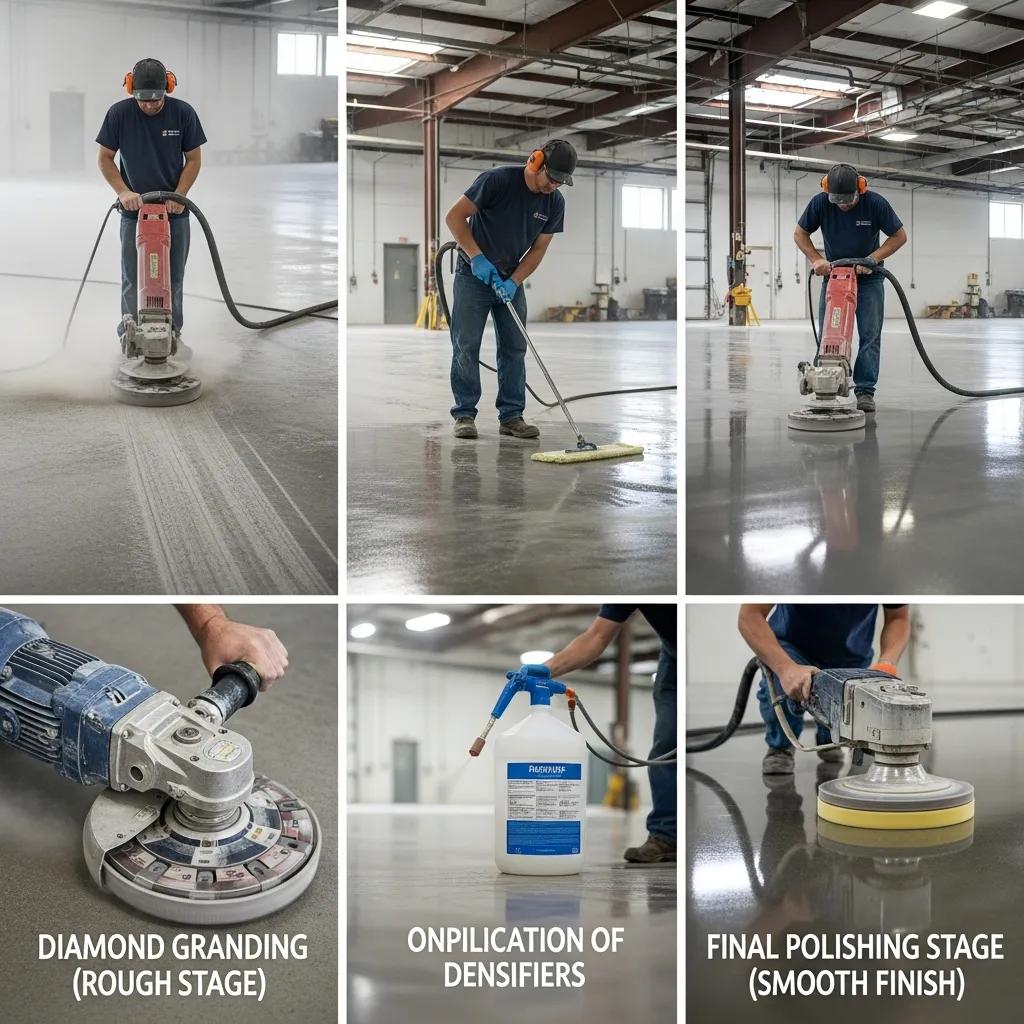
The concrete polishing process begins with an on-site evaluation to confirm slab condition, moisture levels, and repair needs, then moves through a predictable schedule of surface preparation and progressive abrasion. First, technicians perform repairs, remove coatings, and test for moisture to establish readiness; this step reduces the risk of later adhesion or discoloration issues and frames the project’s timeline. Next, diamond grinding proceeds from coarse to fine grits—removing irregularities, exposing aggregate if desired, and smoothing the surface—while technicians select grits based on desired sheen and exposure level. After grinding, a lithium- or sodium- or potassium-silicate-based concrete densifier is applied to chemically react with the cement matrix, reducing porosity and increasing surface hardness; this densification directly improves abrasion resistance and bonding for optional topical guards. Final polishing uses finer diamond tooling and burnishing to reach the targeted sheen (matte to high-gloss), and optional topical sealers or guard coats can be applied for extra stain resistance. These procedural steps determine maintenance needs and long-term lifecycle performance.
What Are the Benefits of Polished Concrete Floors for Greensboro Businesses?
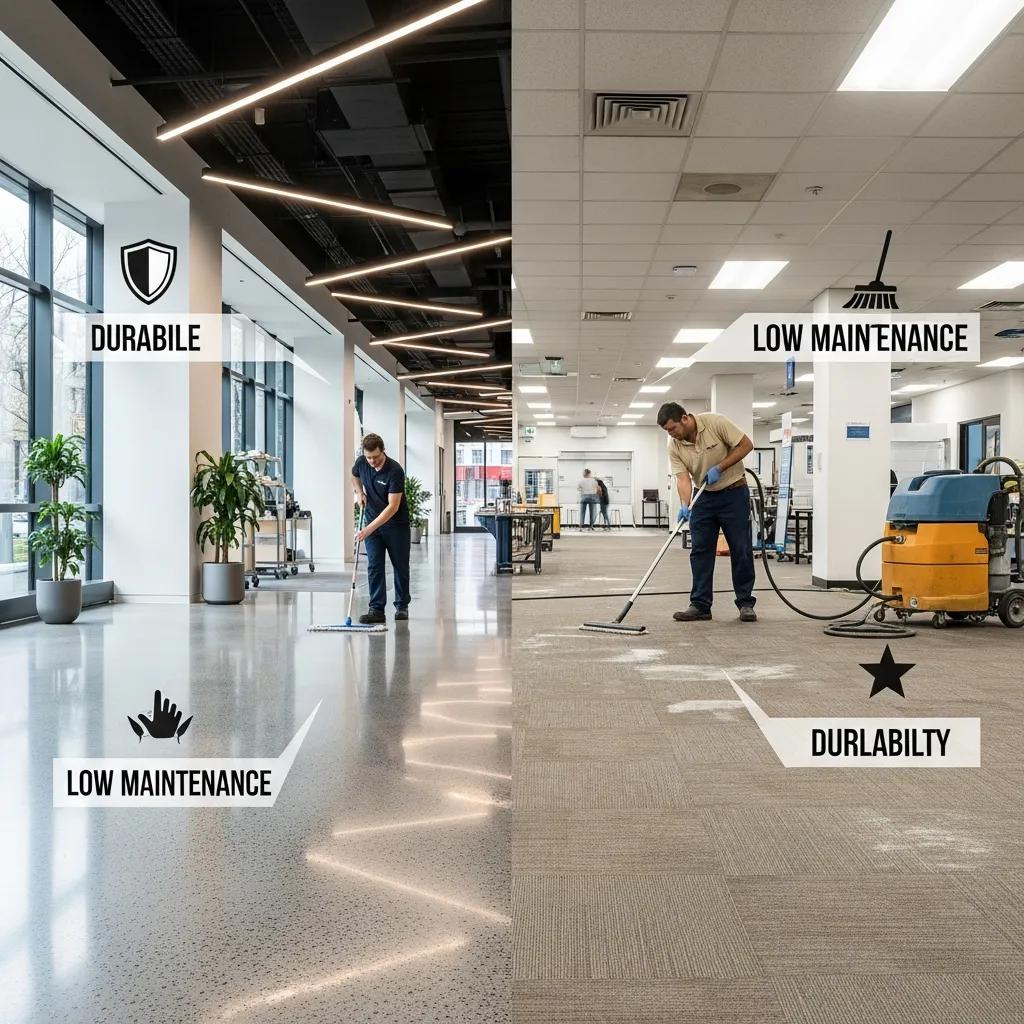
Polished concrete delivers a combination of performance and cost advantages that suit commercial and industrial operations in Greensboro, especially where durability, low maintenance, and lighting efficiency matter. Mechanically, densification and polishing increase surface hardness and abrasion resistance, which reduces grinding or replacement cycles in high-traffic areas. Aesthetically, a polished finish offers adjustable sheen levels and aggregate exposure options that support brand presentation in retail and office environments while remaining practical in warehouses. Operationally, polished slabs reduce maintenance labor and chemical use because the smooth, densified surface resists staining and can be swept or auto-scrubbed efficiently. The following list summarizes the primary practical benefits and sets the stage for an at-a-glance comparison across facility types.
Polished concrete provides measurable operational benefits for different facility types:
- Durability: Reduced wear from vehicular and foot traffic prolongs service life.
- Low Maintenance: Smooth, non-porous surfaces require less frequent deep cleaning.
- Energy Efficiency: Increased light reflectivity reduces artificial lighting needs.
- Aesthetic Flexibility: Sheen and aggregate exposure options adapt to design goals.
These benefits vary by facility type and use case, which helps determine the optimal finish and maintenance plan described next.
Introductory table comparing benefits across common facility types in Greensboro:
This table highlights how the core advantages of polished concrete—durability, maintenance savings, cost efficiency, and light reflectivity—translate into measurable value for different operations. The next section explains how densification and maintenance practices create those outcomes in practical terms.
For Greensboro property owners seeking installation, local concrete polishing specialists can provide site assessments, finish recommendations, and sample panels to illustrate sheen and aggregate exposure without requiring proprietary contact information. These specialists typically review slab condition, traffic patterns, and aesthetic goals during a consultation and can deliver tailored proposals and timelines. Requesting an on-site demonstration or sample patch helps owners visualize outcomes and ensures finish levels meet operational needs. If you want a tailored proposal, ask a local contractor for a site visit and a written estimate that describes prep work, proposed grits, densifiers, and optional guard coats.
How Does Polished Concrete Improve Durability and Maintenance?
Densifiers chemically react with cement hydrates to form additional calcium silicate hydrate (C-S-H) within the pore structure, reducing porosity and increasing surface hardness; this chemical change is central to durability improvements. Reduced porosity limits stain penetration and makes the slab easier to clean, while increased surface hardness improves resistance to abrasion from forklifts and pallet jacks—common stressors in Greensboro warehouses and distribution centers. Routine maintenance is straightforward: dry sweeping or dust-mopping, periodic auto-scrubbing with pH-neutral cleaners, and scheduled inspection for spalls or joint damage. Over the long term, repolishing or applying a topical guard coat every few years restores sheen and enhances chemical resistance, which typically results in lower total cost of ownership than covering or replacing floors. Understanding these maintenance mechanics helps property managers plan for predictable upkeep and lifecycle budgeting.
Which Industries in Greensboro Benefit Most from Commercial and Industrial Concrete Polishing?
Several industry verticals in Greensboro see immediate gains from polished concrete due to their specific traffic, hygiene, or aesthetic demands. Warehousing and distribution centers benefit from high abrasion resistance and easy mechanized cleaning, lowering downtime and repair cycles. Manufacturing floors and light industrial plants value chemical and impact resistance, plus the option to specify slip-resistant finishes in designated zones for safety. Retail and office environments prioritize aesthetics and light reflectivity to enhance customer experience and reduce electricity usage. Food processing and healthcare facilities gain hygienic benefits when polishing is combined with proper joint detailing and coatings in critical zones to meet sanitation protocols. These industry-specific advantages inform finish selection and operational maintenance that will be described in the following examples.
Polished concrete is applied differently depending on operational needs:
- Warehouses: Prioritize abrasion resistance and traction markings for vehicle lanes.
- Manufacturing: Focus on chemical resistance and localized repairability.
- Retail & Office: Emphasize reflectivity, color options, and low-VOC maintenance.
Mapping benefits to industry requirements clarifies why finish level and maintenance frequency differ among sectors, which we explore in the next subsection.
What Are Common Applications of Polished Concrete in Greensboro’s Industrial Facilities?
In industrial settings across Greensboro, polished concrete is commonly used for distribution floors, assembly areas, loading docks, and service corridors where heavy equipment and frequent traffic are routine. Finish levels are selected to match the operational profile—lower-sheen, higher-traction polishes for forklift lanes and higher-sheen, decorative polishes for customer-facing production showrooms. Chemical exposure zones may receive an additional topical guard or a hybrid approach (stain + polish) to increase resistance to specific fluids, while integrated line striping and embedded signage help maintain safety and workflow. Safety considerations such as slip resistance, joint repair, and localized sacrificial coatings in spill-prone areas are essential to maintaining uptime. These application details inform the contractor’s scope during an on-site estimate, which influences cost as discussed next.
How Is the Cost of Polished Concrete Determined in Greensboro, NC?
Cost for polished concrete in Greensboro is determined primarily by square footage, existing slab condition, and the desired finish level—each is an explicit cost driver that shapes labor, materials, and schedule. Slab condition affects prep time: heavy repairs, removal of coatings, or moisture mitigation increase upfront costs, while a sound slab with minimal repairs requires less grinding and fewer materials. Finish level (from a light grind/matte sheen to high-gloss/aggregate-exposed finishes) drives labor intensity and tooling expense because finer grits and additional polishing passes take more time. Secondary factors include site access, staging, timeline constraints, and optional add-ons such as stains, dyes, topical guards, or line striping. Below is an EAV-style breakdown to help owners understand how each factor influences a final quote and where to request clarifying details during contractor bids.
Introductory table that breaks down cost drivers:
This table clarifies that quotes vary because multiple interacting attributes determine labor and materials. For actionable buying guidance, consider the checklist below before requesting an estimate.
Practical steps for obtaining a reliable quote include preparing the slab history, noting traffic patterns and equipment types, and asking for a line-item estimate that separates prep, grinding, densifier, polishing, and optional coatings. When contractors assess a site, they will typically perform moisture testing and inspect for prior coatings or contamination that affect preparation scope. Because cost ranges depend on these specifics, property owners should request an on-site estimate or sample patch to see proposed finish and confirm the scope. A local contractor can provide a tailored quote after inspection; asking for references to similar local projects can validate experience without relying on generic claims.
What Factors Influence the Price of Polished Concrete Floors?
Several distinct factors influence the price of a polished concrete project and each factor should be discussed during bidding to control surprises. Primary drivers include square footage and desired sheen or aggregate exposure, since both impact the number of grinding passes and fine tooling required. Slab repair needs, such as spall repairs, crack stitching, or removal of old coatings, add direct labor and materials to the scope; moisture remediation or topical primers are additional line items when vapor drive is present. Accessibility, production schedules, and required downtime create logistical costs—work conducted during off-hours or in live facilities usually increases the price. Finally, add-ons like decorative stains, colored dyes, joint sealing, or line striping further increase material and labor costs; these should be itemized in bids so owners can compare apples-to-apples. Understanding these elements allows owners to prioritize which attributes to include during procurement.
How Does Polished Concrete Compare to Epoxy Flooring in Greensboro?
Polished concrete and epoxy flooring are both common in commercial and industrial spaces in Greensboro, but they differ in lifecycle, maintenance, aesthetics, and failure modes. Polished concrete is the slab surface itself transformed through grinding and densification, which eliminates the risk of delamination and offers superior abrasion resistance over time; it also provides higher light reflectivity without added coatings. Epoxy systems are topical membrane coatings applied above the slab that deliver a uniform colored surface and chemical resistance when intact, but they can chip or delaminate under heavy impact or substrate movement and may require periodic reapplication. Maintenance for epoxy often involves recoating and patching, while polished concrete typically needs routine cleaning and occasional burnishing or repolishing. The brief comparison below helps owners select the system that matches expected traffic, chemical exposure, and aesthetic goals.
Key pros and cons in bullet format:
- Polished Concrete (Pros): Long lifecycle, no delamination risk, high LRV, low maintenance.
- Polished Concrete (Cons): Limited color uniformity without dyes, prep can be invasive.
- Epoxy (Pros): Wide color and pattern options, strong chemical resistance when fully adhered.
- Epoxy (Cons): Potential for delamination, higher lifecycle maintenance in heavy-impact settings.
What Are the Advantages of Polished Concrete Over Epoxy Flooring?
Polished concrete offers several advantages that make it preferable in environments where longevity, abrasion resistance, and light reflectivity matter most. Because polishing modifies the slab itself rather than adding a separate layer, there is no risk of adhesive failure or delamination that can occur with epoxy systems under thermal cycling or substrate movement. Densified, polished surfaces have higher abrasion resistance which reduces grinding or replacement frequency, and their higher light reflectivity (LRV) can lower lighting energy usage in large facilities. Polished floors also avoid solvent-based coatings and often require lower VOC cleaning regimes, supporting indoor air quality objectives. However, epoxy remains a viable choice where seamless color uniformity or extreme chemical resistance is mandatory; selecting the right system depends on operational priorities and budget. These comparative advantages help owners choose the best flooring strategy for each area of their facility.
How Can Greensboro Property Owners Maintain and Extend the Life of Polished Concrete Floors?
Maintaining polished concrete requires a structured routine that preserves sheen, limits abrasion, and prevents chemical damage, thereby extending service life and retaining the floor’s reflectivity. Daily maintenance typically includes dry dust-mopping or sweeping to remove grit that causes abrasion, while weekly or as-needed auto-scrubbing with a pH-neutral cleaner removes soils without degrading the densified surface. Periodic tasks include burnishing with a high-speed floor machine and replacing sacrificial mats in entryways to prevent grit migration; for high-traffic industrial zones consider scheduled repolishing or application of a topical guard coat every few years to renew surface protection. Preventive measures—such as prompt spill cleanup, repair of joints and spalls, and controlling point loads—minimize localized failure and prolong continuous service. The checklist below provides an easy reference for maintenance scheduling and decision points for professional restorative polishing.
Maintenance checklist introduction:
- Daily: Dust-mop or sweep to remove abrasive particles.
- Weekly: Auto-scrub with pH-neutral cleaner and soft pads.
- Monthly/Quarterly: Inspect for spalls, reseal joints, and burnish high-traffic zones.
- Every Few Years: Consider repolishing or applying a guard coat to restore sheen.
Following a consistent schedule reduces long-term costs and keeps polished concrete performing at design levels; when wear patterns or stains persist beyond routine care, call a professional for restorative polishing to avoid progressive deterioration.
What Are Recommended Cleaning and Maintenance Practices for Polished Concrete?
Recommended cleaning practices start with pH-neutral cleaners and soft scrubbing tools to avoid abrading the densified surface, while avoiding acidic cleaners, harsh solvents, or aggressive abrasive pads that can dull sheen or damage densified chemistry. Use entry mats and walk-off systems to capture grit and prevent micro-abrasion from tracked-in debris, and establish a routine inspection schedule to catch joint failures, spalls, or heavy stain areas early. For daily cleaning, dust-mopping or microfiber sweeping followed by periodic auto-scrubbing keeps soils suspended and removed without excessive mechanical abrasion; burnishing with the appropriate pad can refresh shine between repolishing cycles. If restorative work is needed, professionals will grind and repolish affected areas and reapply densifier or guard coats as necessary; scheduling these restorative visits before major wear is visible helps avoid larger, costlier repairs. These recommended practices keep polished floors functional and attractive throughout their expected service life.
For Greensboro owners ready to act, local concrete polishing specialists can perform sample patches, provide maintenance schedules, and offer on-site estimates that separate prep, polishing, and optional guard coat line items. Ask contractors for a written scope that includes recommended finish level, maintenance guidance, and timing for future repolishing so you can budget responsibly. If you want to see examples of finish options, request a small demonstration patch during the site visit to evaluate sheen, aggregate exposure, and cleaning behavior before committing to a full-floor scope.

0 Comments